Gorilla Trekking in Uganda: Everything You Want to Know
Blinking at the dark ceiling above me, I reached for my phone. It’s 4am – an hour and a half before my alarm was set to go off, but I knew I wasn’t going to get back to sleep. After ten days exploring Rwanda and Uganda, the time had finally come. Today was our gorilla trek.
Unlike many of my other adventures, gorilla trekking wasn’t something I had always dreamed of doing. But when I ran my first group trip to Antarctica in 2023, it was a conversation that came up. A friend I met on board said it was the best trip she had ever taken in her life, and the rest of us listened in awe as she described the feeling of seeing these incredible animals in their natural habitat.
Three years after being on board that ship in Antarctica, here I was in Bwindi Impenetrable Forest with some of those same girls from Antarctica, and today was the day: we were going to see gorillas.
Or, at least I hoped we would.
Unlike the elusive chimpanzees, they say that Gorilla trekking is a 99% chance of seeing them – it was pretty much guaranteed. But, of course, this is wildlife we are talking about, and anything is possible. Plus, let’s not forget. This was a trek through an area that was literally named impenetrable and everyone I knew who had done this before told me it was one of the hardest hikes that they had ever done.
My Gorilla Trekking Experience
After a quick breakfast, we were on the road to the Bwindi Gorilla Trekking Centre by 7:30am. Luckily, we were staying in Buhoma, so the drive itself only took a few minutes. Once at the centre, we grabbed a seat and watched a group of locals from Ride 4 A Woman welcome us with traditional dance and song.
After our warm welcome, we had a tracker speak to us about what to expect for the day; how we would be broken down into groups, emphasizing the rules of wearing a mask when near the gorillas, listening to our guides, and keeping our distance, as well as a few facts. This was followed by a quick talk from a doctor at the local medical centre, which I think was meant to be reassuring but came across a little daunting, especially when he ended with “maybe you’ll come visit us for one of our treatments.”
Thanks, but no thanks. A hospital visit was definitely NOT on my to-do list for this adventure.
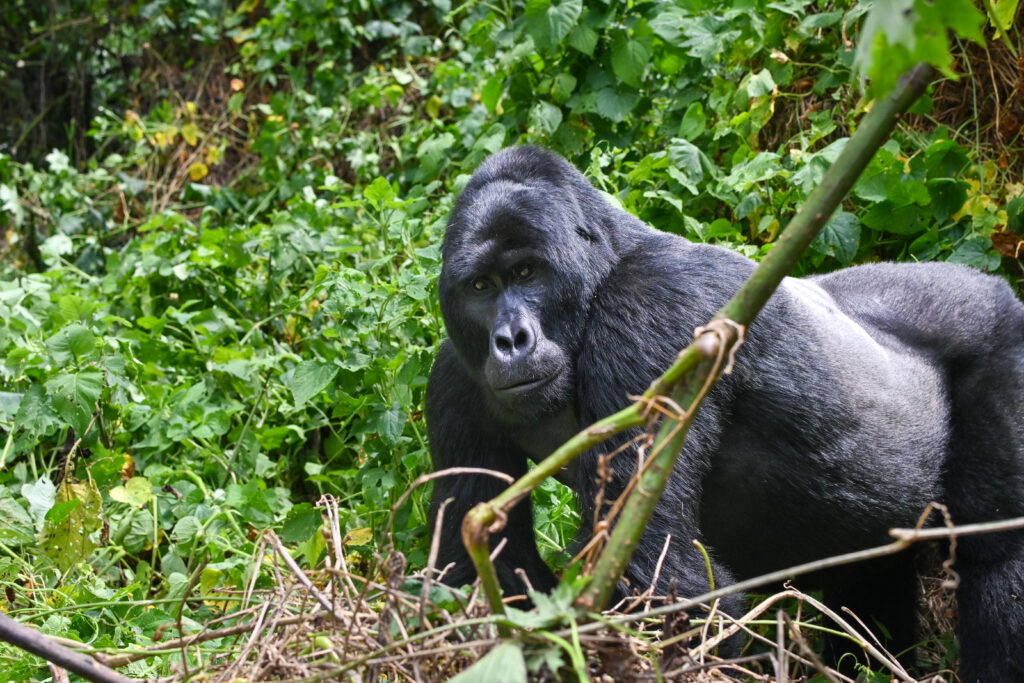
With the speeches over, it was time to be divided into our trekking groups. One group for each family of gorillas and divided by easy/medium/hard treks. Of course, all of that is relative. We are in the mountains, gorillas move, and unless you were one of the extremely lucky people who happened upon them in the first fifteen minutes, you were going to get a workout today.
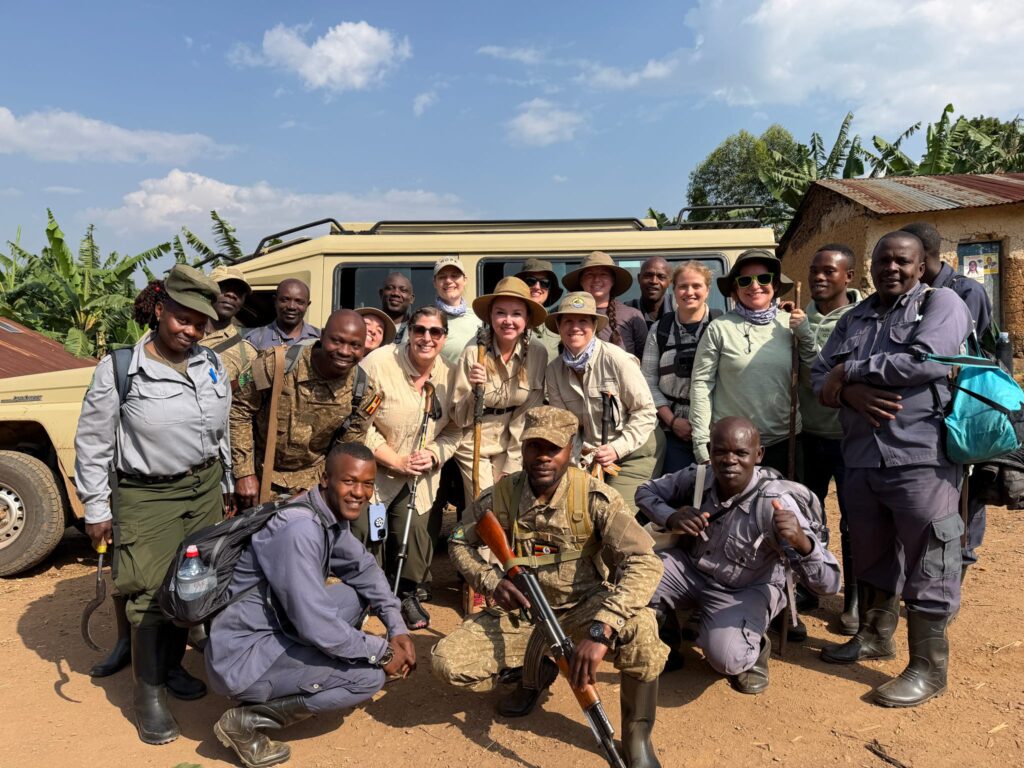
Our group was called up first and, to our delight, we saw we were paired with a female guide. I later learned that our trip guides had visited the gorilla centre the day before to arrange for all 9 of us to stay together as one group (usually 8 people per group is the maximum) and to request a female guide for us. Her name was Kristen, and she was equally thrilled to have an all-female group with her for the day.
Along with Kristen, we had two security guards and two students in training, and after introducing ourselves, she asked who wanted to hire a porter. With a show of hands, she made a call for seven porters to meet us at our starting point, which was not at the centre itself. We filed back into our safari jeeps with our new team members and began our drive up the mountain to where we would start our gorilla trek.
We drove for two hours. Up winding, bumpy, mountain road. The views were stunning, but it was a much longer drive than any of us anticipated. It wasn’t until about 10am that we reached our destination; our jeeps leaving us in a small village where we met our porters and began the trek itself.
The trek started easily, a gradual downhill slope down a narrow dirt road with banana trees. We chatted animatedly, all bubbling with excitement as we got to know our guide and porters. But about ten minutes later, we stopped on the road and turned to face the steep hill beneath us. And let’s just say that descent shut us up really quickly, as all attention was then focused on where to put our feet.
The first part of the descent was through a farming field, which was nice because it was clear, but it was crazy steep. At first, we tried to treat it like a switchback, but that didn’t last long, and we ended up walking down sideways on the edges of our feet; all very grateful for our walking sticks. At one point, there was a thicket of thorns and branches with a small hole for us to, essentially, crawl through.
Then we got to the actual forest itself, and we immediately understood why it was called impenetrable. There were a few parts that were path-like, but our guide and security frequently hacked at vines and branches with their machetes to make a path. We ducked under branches and climbed over rocks and fallen trees while thorns and thick vines grabbed at our ankles. It was slow going, yet the heat, altitude, and stress of making sure we were putting our feet down in a safe space meant we were all sweating heavily. We had to change routes a couple of times after learning that, despite their early morning start, the trackers still hadn’t located the family we would be visiting. All the while, we were still going down, down, down the mountain.
I fell. Twice.
But after about two hours of trekking, we found them. My first glimpse of a mountain gorilla was the baby, peeking his head out of the bushes as he heard our arrival. We dropped our bags, grabbed our cameras, strapped on our face masks and followed our guide and the trackers into the clearing where the gorillas were eating.
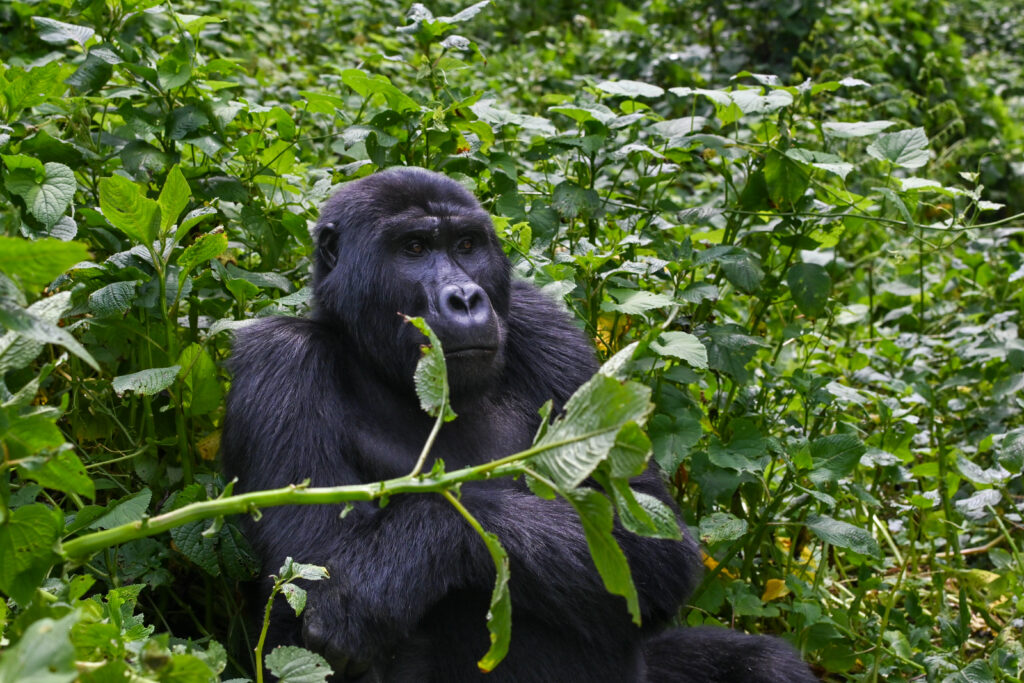
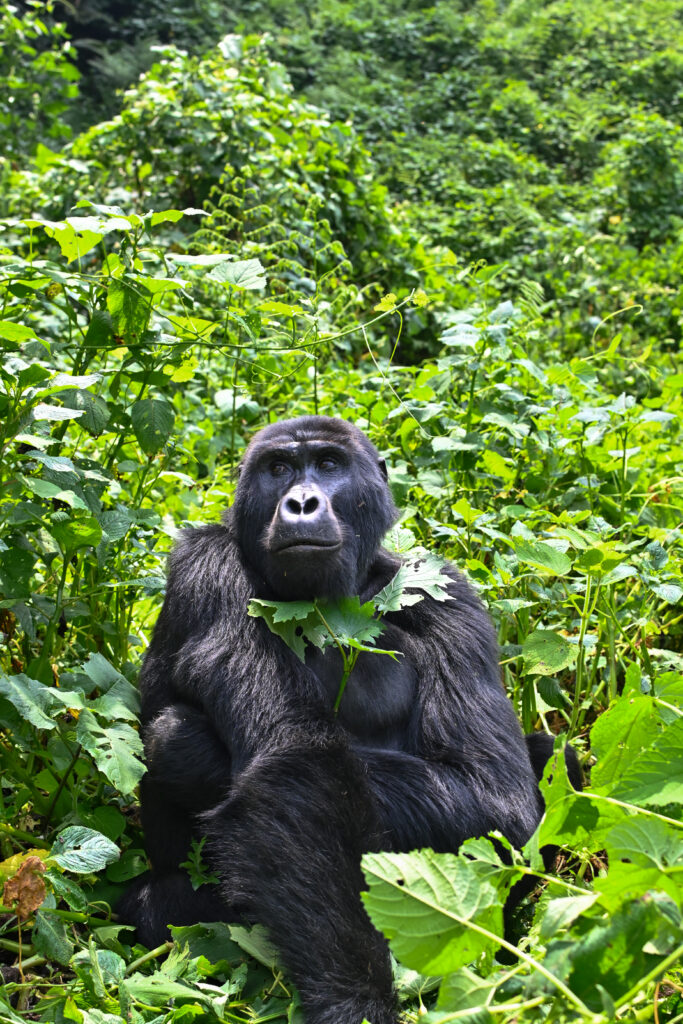
Despite tracking a family of 9, we actually only saw 5, plus the baby, and got close to 3 (plus the baby). Gorillas spread out when they eat, so we saw a couple from a distance, but a few remained hidden. However, we got to spend some quality time with the mother and the baby, who I am convinced would have come right up to us if mama allowed, but she kept pulling him back.
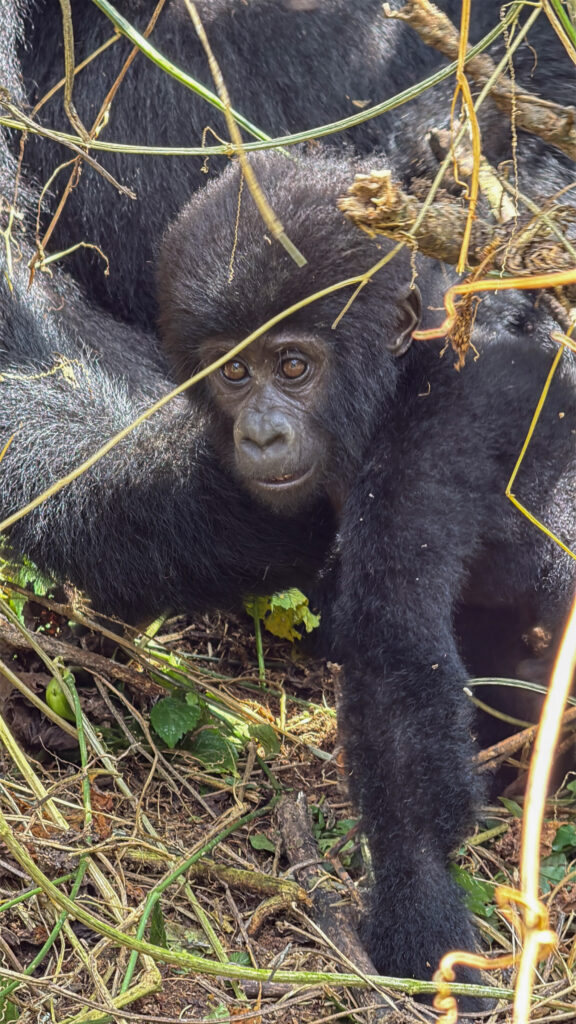
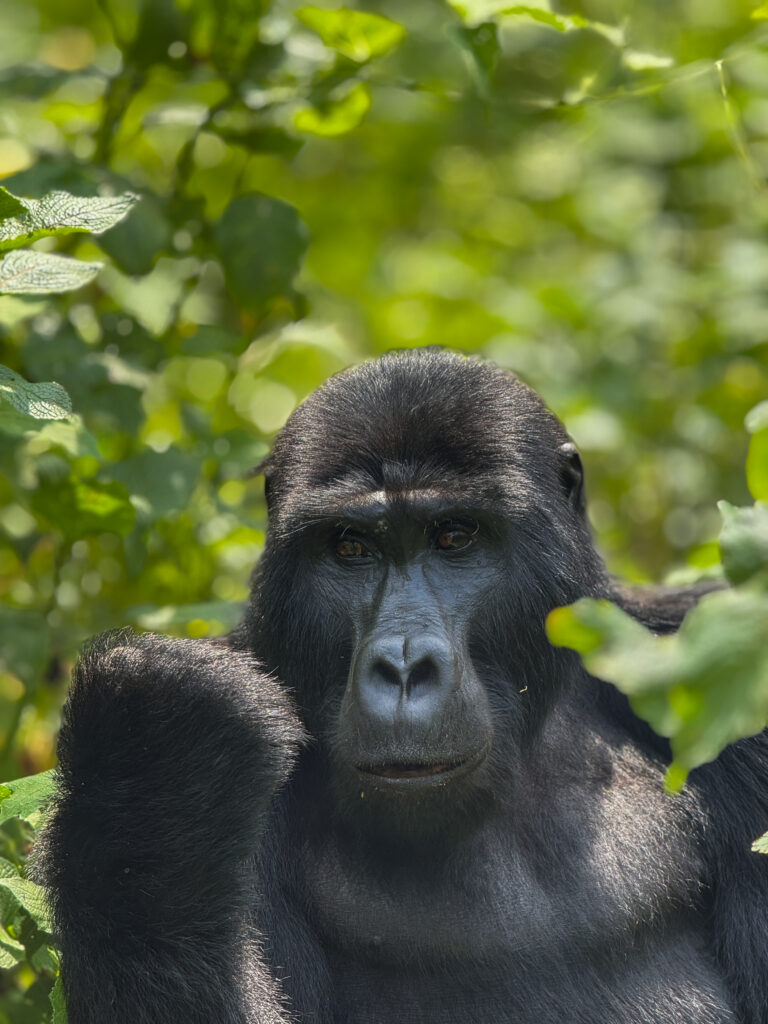
We then had an adult female who was essentially a model. She knew how to work her angles and hammed it up for the cameras. And, the main silverback of the group. I honestly think he felt left out for a bit as we were focused on mom and baby and our posing female, because he just walked straight through our group to sit down and get some attention for himself. Although when he started picking his nose (AND EATING IT!), we all burst out laughing, so he ducked down, embarrassed, in the bushes.
We got to spend an hour with the gorillas and were far closer than I ever imagined. The goal is to stay 10m away from them, but we were in a small area, still on a steep part of the mountain, and the gorillas had no issues walking right beside us. However, at no point in time did we ever feel threatened or unsafe. They genuinely seemed so gentle and as curious about us as we were about them. As much as I wanted to take a million photos, I found myself trying to focus more on being in the moment with them- it was truly incredible and felt so special. Hands down, one of the coolest things I have ever done in my travels.
Just about as our hour with them was up, the gorillas decided they were done posing for photos and moves deeper into the bush out of the heat of the sun. We let them go, saying goodbye as we made our way back to our bags to pack away our cameras and grab some water before making the hike back.
Remember when I said the whole route was down, down, down?
That means we then had to go up, up, up.
And wow, it sucked.
It was hot, we were already tired after 2 hours hiking down, then the hour moving around with the gorillas, plus for most of us, we were dealing with huge differences in elevation. My hometown is 70m above sea level, whereas we were around 2500m and as an asthmatic, this also played havoc with my lungs.
That being said, we took our time, and nobody rushed us. When I needed to stop to catch my breath and take my inhaler, everyone was happy to give me a couple of minutes. The porters we hired offered to help along the way, pushing or pulling as needed. I preferred to do it myself, but it was nice to know that my porter, Caleb, was there for an extra hand when needed.
When we broke through the forest bit, we stopped for 15 minutes to have lunch. For most of us that meant a protein bar or banana and water – it was too hot for me to think about eating an actual sandwich. Then it was back up through the steep farmer’s field, which was still tough but a bit easier without all the thorns and vines grabbing at our ankles.
The hike back up took about an hour, with an elevation gain of 361m. The whole journey itself (including time with the gorillas) was just over 4 hours, but we only went 3.64km. I’m pretty sure that final stretch back up the mountain was only 1km. I wasn’t kidding when I said it was steep.
We were dirty, sweaty, and absolutely exhausted by the time we reached the town and our jeeps. Our guide said our trek qualified as a ‘medium’ level. Was it the toughest hike I’ve ever done? Yes, I think so. But wow, it was so worth it.
Is Gorilla Trekking Considered Ethical Animal Tourism?
Responsible and ethical travel, especially when it comes to wildlife, is incredibly important to me as a traveller. I knew going in that there were many precautions and regulations around gorilla trekking:
- Only a certain number of permits are given per day, which means this is an activity that should be planned well in advance.
- We had to wear face masks because we share 98% of our DNA, and it has been discovered that illnesses can pass between species.
- We had to make every effort possible to stay 10m away as much as possible (easier said than done!)
- We would only spend a maximum of 1 hour with the family.
- Groups are usually limited to 8 hikers. (We were lucky enough to have our trip guides vouch for our group of 9 to let us stay together and luckier that the gorilla team agreed.)
While the hike is tough, the time spent with the mountain gorillas themselves is considered to be incredibly safe. Gorillas are known to be gentle, but a part of that comes from the fact that they are used to humans. Between the trackers, trekking groups, and doctors that sometimes visit, these mountain gorilla families see humans on a daily basis. Which, in theory, is less than ideal.
However, when our group visited the Gorilla Doctor’s HQ in Musanze, Rwanda, we learned just how much of an impact tourism is having on the population of mountain gorillas – in the best way.
In the 1970s and 80s, it was estimated that there were only about 250 mountain gorillas remaining. They had been hunted and poached for years, with trappers trying to capture babies for zoos around the world. Since gorillas are so protective of their families, it is estimated that 3-4 adult family members had to be killed in order to capture one baby. Furthermore, the traps themselves ended up injuring and killing the gorillas in the wild. The population was on the road to extinction.
But then, tourism arrived. Visitors from around the world came to this region to trek for them, which meant sustainable job opportunities for the local community. As Gorilla tourism picked up, the poaching and hunting stopped and as of the last census, there are now 1063 mountain gorillas.
Tourism has literally brought this species back from the verge of extinction. And sure, in an ideal world, they wouldn’t need us. But for now, it’s a type of animal tourism that you can, genuinely, feel good about.
What I Wore & Packed for Gorilla Trekking
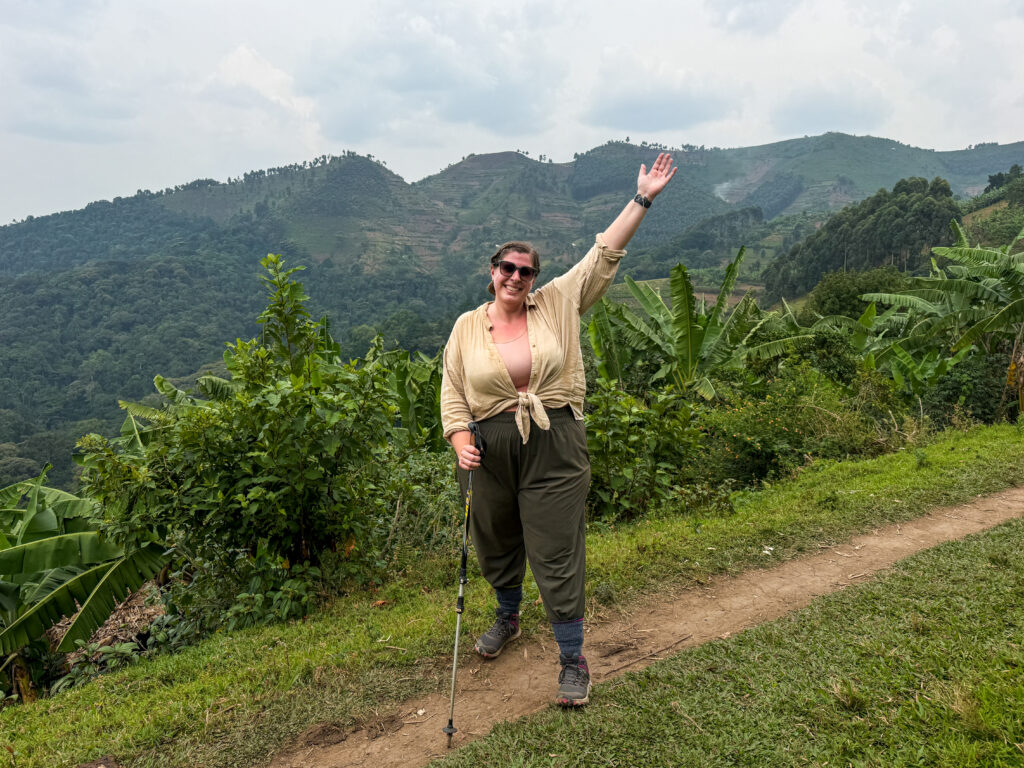
As you can tell from my story above, this was quite the hike, which means you want to make sure you are dressed appropriately. I will also tell you that no matter how cute you look, you will likely still be covered with sweat. And I don’t just mean a sweaty face or underarms. I mean swampass. Yes, I said it. Yes, we all had it and yes, you can see it in some photos (super cute, not). So just keep that in mind.
Since we had part of our hike in open farmer’s fields and the rest in the forest, we wanted to make sure everything was covered to protect against the sun as well as bugs and the forest itself- there are lots of thorny plants! I was literally picking them out of my clothes after the fact.
I wore a loose linen-blend button-down over a tank top (with a sports bra underneath) and looser hiking pants. Long socks that you can pull over your pant legs are a MUST, as fire ants are quite common. You can also bring gators.
Gardening gloves came recommended as well. I didn’t have any and did fine, but I can see why you might want them. There were a couple of spots where we crawled. That being said, a lot of the girls who did have them kept taking them off because they got really warm.
A hat and sunglasses will also come in handy. I had a ballcap, which I ended up not wearing because it got in the way of my camera. Some of the other girls had safari style hats like this and didn’t have that same problem because they were more flexible.
Sunscreen is good to have on hand and, of course, bug spray. We were told that there have been issues recently of some bugs actually being attracted to the smell of bugs pray so were encouraged to either not wear it and just cover up, or spray before we left the lodge so it had time to ‘sink in’. I sprayed myself with this product (deet-free, but recommended to me by my travel doctor) and had zero issues with bugs.
We were lucky and had dry weather, but we all had raincoats packed away in our bags just in case. If you are carrying camera gear, I also recommend a waterproof cover for your camera bag or backpack to protect your gear.
And for footwear, hiking boots! I bought a pair of lightweight ones from Merrell that fit so well and packed really easily. They were so comfortable and I had zero issues with blisters.
As for the backpack I had:
- 2 litres of water and a couple of packets of electrolytes (I drank it all by the end and used a packet of electrolytes at our lunch stop)
- Protein bars (we also had packed lunches, but I was too hot to actually eat that much, so my protein bar came in clutch)
- Raincoat and rain bag cover, as mentioned above
- Compostable toilet paper- just in case. I didn’t need it, but emergency TP is always a good idea.
- A small towel: I sweat BUCKETS during this hike, and it got HOT, so it was really nice to put a bit of water on my towel at our lunch break and just wipe my face and the back of my neck to try to cool down. One of the girls in my group also brought her mini portable fan for our break- that was also so smart.
For camera gear:
- I shoot with a Nikon Z50 mirrorless and have a couple of different lenses. I was unsure about how close we could get, so I brought my 200-500mm, which was WAY too big, and I didn’t end up using it. I also had a 35mm portrait lens, which I used. To be honest, it wasn’t ideal either. I wished I had an 18-140mm or something in that zone. It would have been perfect for my trip. Also, swapping out lenses was a pain in the ass; I don’t suggest bringing more than one.
- Powerbank: I used my cellphone a lot for videos, so I wanted to make sure I stayed fully charged. I use and love this one.
- Backup camera battery and SD card: just in case.
- Cloth for cleaning my lens, just in case.
Also, this is my camera bag. It comes with a waterproof cover and has a hip and chest strap. It fits my big lens with space for some more lenses. I love it for hikes with my camera gear. It’s also easy as a backpack from plane travel.
Should You Hire a Porter for Gorilla Trekking?
YES. For multiple reasons.
First off, it makes a big difference. As you can tell from above, my backpack was heavy. I carried it myself for the golden monkey trek and Chimpanzee treks I also did on this trip, but they weren’t nearly as difficult as the gorilla trek. I was very grateful to have someone who was more familiar with these hills and steadier footing than me take care of my camera.
On top of carrying my bag, my porter also brought me a walking stick and served as support for the entire hike. He stayed beside me, offered me a hand when needed and helped find the easiest ‘path’ and places to step. He also offered to push and pull when needed, but I am stubborn and refused that help, determined to do it all on my own. Some of the other girls in the group did benefit from this type of assistance at some points. Again, the trek is STEEP.
Finally, even if you think you are super fit and have a light bag and don’t need the help. It’s also an easy way to support local and give back to the community. Most of the people here are farmers and make about 2-3 USD a day. The $20 USD you pay for your porter makes a difference and continues to support gorilla tourism in a responsible way.
Tipping on Your Gorilla Trek
Tipping as a tourist is huge in Africa, and tipping on your gorilla trek is no different. There are also a lot of people involved in your trek. Despite coming from a tipping culture, I am still a big believer that tipping is always up to you. That being said, these teams put in a lot of work. So, if you are looking for a guideline, this is what we did.
- Porters cost $20 USD, but most of us tipped an extra $10 USD+ (they put in the work!)
- For our guide, we each gave her $10 USD
- For the trackers (we had a couple), each of us gave $10 USD for them to split between them.
- For our security (we had 2), each if us gave $10 for them to split between them.
The trackers you will tip once you say goodbye to the gorillas. Everyone else you tip (and in terms of the porters, pay) at the end.
Tips can be in USD or the equivalent of Ugandan shillings. Just make sure you have the right amounts, don’t expect them to make change.
Gorilla Trekking FAQ
How much does it cost to go gorilla trekking?
Mountain gorillas can only be found in three countries: Rwanda, Uganda, and DCR. Due to current safety concerns, tourism to DCR is not recommended. In Rwanda, a permit (2026/2027) is $1500 USD. In Uganda, it’s $800 USD. Keep in mind this is only the permit for the trek and does not factor in any other costs.
Is gorilla trekking difficult?
Yes. I’m not going to sugarcoat it; it’s in the mountains, at a high elevation, through thick jungle/forest, and you have no idea how long you will be hiking for. Some people see gorillas in 20 minutes. Some people hike for four hours. That being said, all kinds of people do it. I’m plus-size and an asthmatic, and I did it. I’ve also heard of people in their 80s doing it. If you are in good health, it’s definitely doable.
Is gorilla trekking safe?
The forest and gorillas themselves are typically safe (again, this is wildlife and nature, so everything is possible). You have experienced trackers, a guide, and security with you, and it’s not a rush. But again, while not a race, this trek can be very tough. People have had heart attacks while hiking here, so you want to make sure you are in good enough physical condition.
Is there another way to visit the gorillas other than hiking?
If you don’t want to trek, you can take the African Helicopter. But don’t get too excited because it looks and sounds terrifying. Essentially, you are on a board while a team of porters carry you in. You might get to sit. You might be lying down. You might get a seatbelt, but you also might not. This service starts at an addition $300 USD.
Having done the hike, I genuinely cannot imagine how terrifying it would be to be carried on that uneven ground and up those hills. I would rather crawl in the rain than do that.
Ready to Book Your Trip?
Don’t forget travel insurance!
Please do not travel without travel insurance! I’ve had to use it multiple times throughout my travels and it has saved me thousands of dollars. You can learn more about travel insurance here. If you are looking for a provider I love and recommend SafetyWing. New Nomad Essential users can get 8 weeks of free electronic coverage for free with promo code HL10.
For Canadian readers, take a look at SoNomad for competitive insurance pricing.
*As always, make sure to read the fine print to understand exactly what your insurance covers.
Book your accommodation
I love and recommend booking.com for accommodation. They have a range of hostels, guesthouses, hotels, and resorts. Plus, the platform has a great loyalty program that means the more you book, the more you can save.
Book your tours
My go-to tour provider that I love to recommend is GetYourGuide. They have options all over the world and partner with local companies for everything from day trips to food experiences and even airport transfers.
Get connected
If you want to have data while travelling for online maps or any other needs, an esim is one of the easiest solutions. I have used esims around the world from Brazil to Uzbekistan, Greece to the USA- they are super easy and you don’t risk losing your home sim! There are two brands I have used and recommend so I suggest comparing both.
Airalo: download the app, pick what country you want an esim for, and after you purchase it follow the installation instructions. You can use promo code HANNAH3326 to save $3USD on your next esim purchase.
Sim Local: Another easy to use alternative with competitive pricing. Here’s my link with a promo code.
Truely: This one is easier in that it’s a one-time download instead of downloading an esim for each country. It also allows you to hotspot and tether- which not all esims do. Check out options here.
Not sure what to pack?
I have destination-specific guides for some countries but you can also check my travel essentials and camera gear if you are looking for some ideas.
Looking for a travel buddy?
Check out my group trips!
I’m going gorilla trekking in June and this post gave me the first true glimpse into what to expect.
I absolutely hate going down steep hills, haha! I’d rather go up all day. You give me hope knowing there are walking sticks available and the possibility of a helpful push from a porter.
Haha lots of ups and downs but yes, absoltuely hite a porter! So worth it!